A blood pressure reading measures pressure in the arteries. It is not, by itself, a diagnosis, a medication plan, or a reason to change a dose you already take. The useful next step is a set of questions for a clinician, and a clear account of why two readings of the same person can disagree.
Canby Community Clinic describes primary care as a place to discuss new symptoms, ongoing concerns, and follow-up, and preventive care as room for screening conversations and measurements. Both pages say availability and the right service depend on the person and on current guidance. This article does not say the clinic diagnoses or treats hypertension. Call and ask whether a blood pressure question is something the clinic can see you for.
High blood pressure often has nothing you can feel
The Centers for Disease Control and Prevention’s page on measuring blood pressure, updated September 4, 2026, states that measuring is the way to know whether blood pressure is high, because high blood pressure usually has no warning signs. The same page says high blood pressure can put a pregnant person and a baby at risk, and it points to separate CDC material on pregnancy. This clinic’s pages do not describe obstetric care. If you are pregnant, use that CDC page and a clinician who provides prenatal care. Do not treat a community-clinic article as prenatal advice.
The U.S. Preventive Services Task Force, in its recommendation of April 27, 2021, states that hypertension affects approximately 45 percent of the adult U.S. population and is a major contributing risk factor for heart failure, heart attack, stroke, and chronic kidney disease. That figure is the Task Force’s summary of the condition’s reach. It is not a count of patients at this clinic, and it is not a prediction about any one reader.
What the screening recommendation actually says
The Task Force gives an A grade to screening adults 18 and older who do not already have hypertension. Screen in the office. Confirm the reading outside the clinic before treatment starts, with a portable monitor worn for 12 to 24 hours or an automated home cuff. Take it at the upper arm, with a validated device, while seated, after five minutes of rest.
Evidence on how often to screen is limited. The Task Force calls yearly screening reasonable from age 40, and for adults at higher risk, including Black adults, people with a high-normal reading, and people with overweight or obesity. Every three to five years is the option it describes for adults 18 to 39 who are not at increased risk and whose last reading was normal. That is a national panel’s suggestion. It is not a schedule this clinic has published, and it is not a reason to postpone a visit a clinician already asked for.
Cutoffs are not uniform. The Task Force notes thresholds from 130/80 mm Hg or greater to 140/90 mm Hg or greater, and it reviewed studies that used any of them. It defines sustained hypertension as repeated high readings over time and in more than one setting. One afternoon does not meet that definition. This page will not assign a personal target. Ask the clinician who can see your age, other conditions, pregnancy, and medicines.
An office reading misses some people and alarms others
The Task Force compared office measurement with ambulatory monitoring. In a pooled analysis of 15 studies, an office threshold of 140/90 mm Hg had a sensitivity of 0.54 (95 percent confidence interval, 0.37 to 0.70) and a specificity of 0.90 (95 percent confidence interval, 0.84 to 0.95), against ambulatory references of 130/80 over 24 hours or 135/85 during the day. That sensitivity means the office test, in those studies, missed many people whose ambulatory readings met the study definition. The interval around 0.54 is wide, so the size of the miss is uncertain. Studies that reported race and ethnicity were mostly of White participants. Use the figure as a caution about one office reading, not as a score for your own cuff.
A high office reading can also point the other way. The CDC, citing an American Heart Association statistics report, says as many as 1 in 3 people with a high reading in a doctor’s office may have normal readings outside it. Clinicians often call that white coat syndrome. It is one reason the Task Force wants a reading confirmed outside the clinic before treatment starts. Ask about the number. Do not start, stop, or change a medicine because of this page.
How the measurement itself moves the number
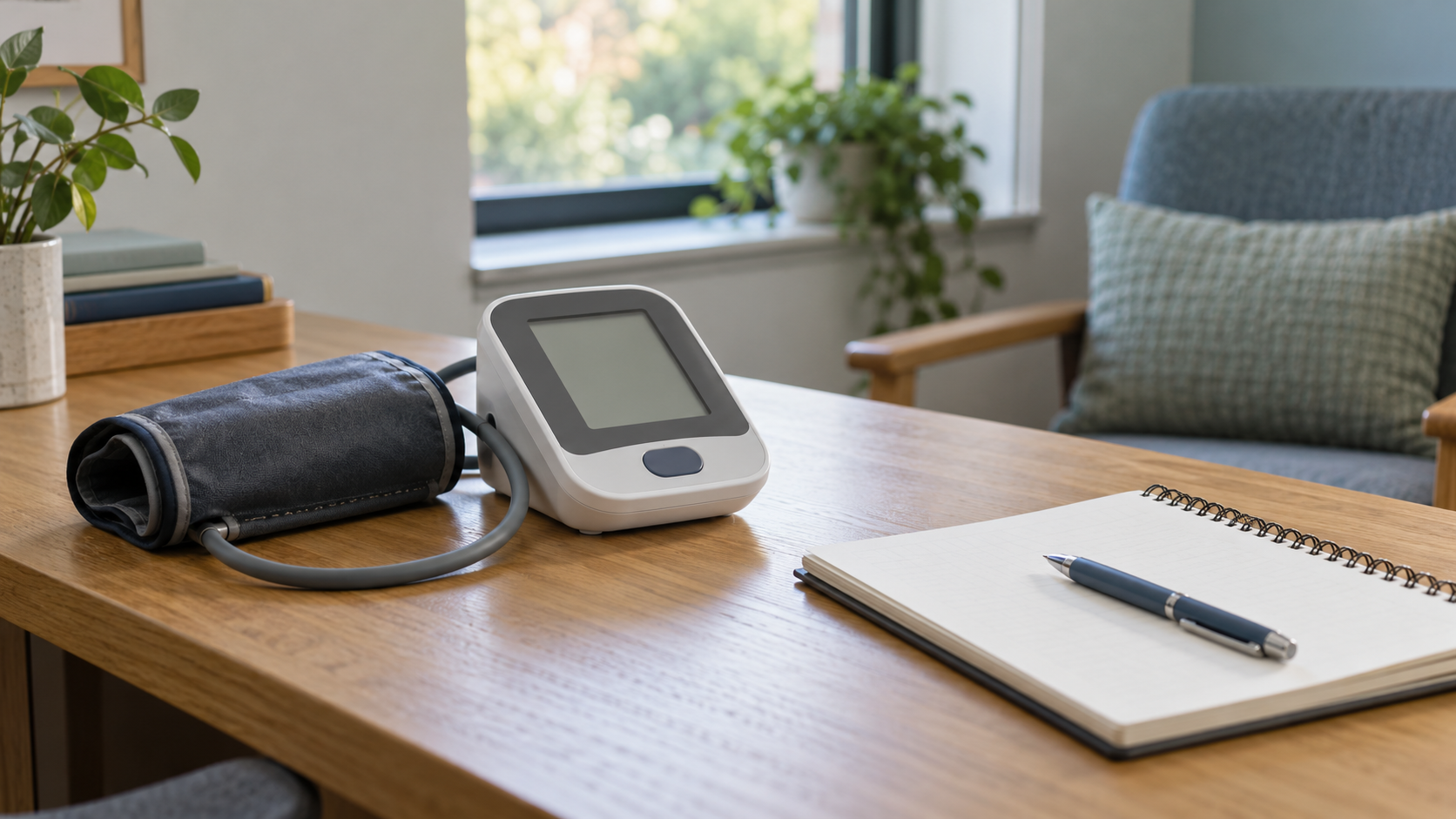
The CDC checklist is specific. Do not eat or drink for 30 minutes beforehand. Empty your bladder. Sit with your back supported for at least five minutes, both feet on the floor, legs uncrossed. Rest the cuffed arm on a table at chest height. Use a cuff that is snug on bare skin, not over clothing. Do not talk while it runs. Caffeine, alcohol, smoking, or exercise in that half hour can also raise the number.
If you measure at home, the CDC says people with high blood pressure are more likely to lower it when home monitoring is combined with help from a health care team than when they do not monitor at home. The page gives no expected drop, and this article will not invent one. The habits it describes are a written log, readings at the same time of day, and at least two readings one or two minutes apart. Ask a clinician whether home measurement is useful for you. A cuff that has never been checked against a validated device can be wrong with great confidence.
An office, a pharmacy machine, and a home monitor are different settings. Write down where the reading happened, the time, and whether you had climbed stairs or finished coffee. Bring that note with a medication list. Some products on the list are taken for blood pressure, and some can raise it.
Questions to take to the visit
Ask these, and write the answers:
- What was the reading today, on which arm, and was it repeated after I had been sitting quietly?
- Does this need to be confirmed outside the office before anyone talks about treatment?
- If you want home readings, what should I write down, and what kind of cuff should I use?
- Which of my current medicines, if any, are for blood pressure, and am I taking them as prescribed? Do not change them because of this article.
- What would make you want to see me again, and what should I do if I feel seriously ill when the office is closed?
The closed-office answer, from this website, is to call 911 for a medical emergency. For a non-emergency question about scheduling, the published clinic number is (818) 674-4414, Monday through Friday, 9 AM to 5 PM. Ask the clinic whether it wants you seen for this reading. Preparing for a first visit still applies: bring the log, the list, and the question you ranked first.
Sources
- U.S. Preventive Services Task Force. Hypertension in adults: screening. April 27, 2021. Grade A recommendation, screening intervals, thresholds, the 45 percent figure, and the office-measurement accuracy numbers quoted above.
- JAMA version of the 2021 USPSTF recommendation statement. DOI 10.1001/jama.2021.4987, linked from the Task Force page.
- Evidence summary linked from the Task Force page. DOI 10.1001/jama.2020.21669. Accuracy figures above are quoted from the Task Force page, which cites this summary.
- Centers for Disease Control and Prevention. Measuring your blood pressure. Updated September 4, 2026. Checklist, white-coat figure, and home monitoring with team support.
- Virani et al. Heart disease and stroke statistics—2020 update. Circulation. DOI 10.1161/CIR.0000000000000757. Cited by CDC for the white-coat figure.
- Kallioinen et al. Sources of inaccuracy in resting blood pressure measurement. Journal of Hypertension. 2017. DOI 10.1097/HJH.0000000000001197. Cited by CDC for factors that raise a reading.
These sources were checked on October 8, 2026. Guidance and enrollment rules change. Use the linked page for the current wording before you act on a deadline.
About this resource
Prepared by Canby Community Clinic as general patient education. For questions about appointments and services, call (818) 674-4414. This information does not replace individualized advice from a qualified healthcare professional.